
DSCR Loan Requirements: How Lenders Calculate DSCR
How DSCR loans work: the rent-to-PITIA formula, the ratio lenders want, how much you can borrow on rent alone, and why 1.25x can still lose money.
10 min readPublished · Updated
A DSCR loan is an investment property mortgage approved on the property's rent instead of your income. The lender divides the monthly rent by the full monthly payment, and if that ratio (the debt service coverage ratio) clears its minimum, usually 1.00x to 1.25x, you qualify without tax returns or pay stubs.
That makes DSCR loans the default financing for a lot of real estate investors: people who are self-employed, people whose tax returns show little income because depreciation wipes it out, and people who hold each property in its own LLC. It also means one ratio decides the whole approval. This guide shows exactly how lenders calculate it, what number you need, how much you can borrow on the rent alone, and the trap that catches new investors: qualifying for the loan is not the same as the property making money.
At a glance
- DSCR = gross monthly rent ÷ PITIA (principal, interest, taxes, insurance, and HOA dues)
- Lenders ignore operating expenses, vacancy, and your personal income
- 1.25x usually gets the best pricing; 1.00x is a common minimum
- Interest-only, a 40-year term, or more down payment are the usual fixes for a short ratio
- A property can clear 1.25x and still lose money each month, so check cash flow separately
What a DSCR loan is, and who uses one
DSCR stands for debt service coverage ratio: how many times the property's income covers its debt payment. A ratio of 1.25x means the rent is 25% more than the payment. A ratio of 0.90x means the rent covers only 90% of it.
DSCR loans are a type of non-QM ("non-qualified mortgage") loan for investment properties. Compared with a conventional investment-property mortgage, they trade a higher rate for looser paperwork:
- No personal income check. No tax returns, pay stubs, or debt-to-income ratio.
- LLC ownership. Most DSCR lenders lend to an LLC, usually with a personal guarantee.
- No ten-property limit. Conventional loans backed by Fannie Mae stop at ten financed properties per borrower. DSCR lenders underwrite each property on its own, though each lender sets its own limit on how much it will lend to one borrower.
They're a poor fit for a home you'll live in (they're for investment property only), and they usually cost more than a conventional loan if you can document income easily.
How to calculate DSCR
For a residential DSCR loan (one to four units), the formula is:
DSCR = gross monthly rent ÷ monthly PITIA
PITIA is the full housing payment:
- Principal and Interest on the loan
- property Taxes
- Insurance (hazard, plus flood insurance where it's required)
- Association (HOA) dues
What's not in the formula matters as much:
- Operating expenses. Property management, maintenance, repairs, utilities you pay, and reserves for big replacements are all ignored.
- Vacancy. Lenders assume the property is fully rented.
- Your income. Your job, your other properties, and your tax return don't enter the calculation.
For the rent, many lenders use the lower of the signed lease and the market rent the appraiser reports on the rent schedule (Fannie Mae Form 1007 for a single-family home, or the rent section of Form 1025 for two to four units). If the property is vacant, the appraiser's market rent is all you have.
A worked example
Priya is buying a single-family rental for $400,000 in her LLC. She puts 25% down and borrows $300,000 at 7.5% on a 30-year loan (an example rate; use the one your lender quotes). The house rents for $3,200 a month. Property taxes are $4,800 a year, insurance is $1,800 a year, and there's no HOA.
| Payment line | Monthly |
|---|---|
| Principal and interest ($300,000, 7.5%, 30 years) | $2,097.64 |
| Property taxes ($4,800 ÷ 12) | $400.00 |
| Insurance ($1,800 ÷ 12) | $150.00 |
| HOA dues | $0.00 |
| PITIA | $2,647.64 |
DSCR = $3,200 ÷ $2,647.64 = 1.21x
The rent covers the payment with about $552 to spare. That clears most lenders' 1.00x minimum but falls just short of the 1.25x line where pricing usually improves.
Note
DSCR loan requirements
Every lender sets its own thresholds, but most price loans in roughly these bands:
| DSCR | What it usually means |
|---|---|
| 1.25x and above | Strong file. Best rate and highest loan-to-value, often 75–80% on a purchase. |
| 1.00x to 1.25x | Rent covers the payment. Most standard programs lend, often with a small rate add-on. |
| 0.75x to 1.00x | Rent doesn't fully cover the payment. Some lenders offer "low-DSCR" programs at a higher rate, a lower loan-to-value, and more reserves. |
| Below 0.75x | Outside most programs. You'll need to change the deal. |
Besides the ratio, lenders also check your credit score, cash reserves (commonly three to twelve months of PITIA in the bank after closing), the appraisal, and the LLC's documents. Many DSCR loans also carry a prepayment penalty for the first few years, so ask before you sign if you might sell or refinance early.
How much can you borrow with a DSCR loan?
Turn the formula around. Divide the rent by the ratio you want, subtract the costs that don't depend on the loan (taxes, insurance, HOA), and what's left is the most you can spend on principal and interest. The loan amount is whatever balance that payment supports.
For Priya at a 1.25x target:
- $3,200 ÷ 1.25 = $2,560 total payment allowed
- $2,560 − $400 taxes − $150 insurance = $2,010 for principal and interest
- At 7.5% over 30 years, $2,010 a month supports a loan of about $287,465
That's about 72% of the price, so Priya would need roughly $112,535 down to hit 1.25x instead of the $100,000 she planned.
At a 1.00x target the same math supports a loan of about $379,000, but that's 95% of the price, and few DSCR lenders go above 80–85% on a purchase. In practice your limit is whichever is lower: the loan the rent supports, or the program's maximum loan-to-value.
Five ways to raise a low DSCR
If the ratio comes in below what you need, either lower the payment or raise the rent. Here's what each lever does to Priya's 1.21x:
| Change | New monthly payment (PITIA) | New DSCR |
|---|---|---|
| None (30-year amortizing) | $2,647.64 | 1.21x |
| 40-year amortization | $2,524.21 | 1.27x |
| Interest-only | $2,425.00 | 1.32x |
| Borrow $287,465 instead (more down) | $2,560.00 | 1.25x |
| Rent of $3,310 instead of $3,200 | $2,647.64 | 1.25x |
- Interest-only is the strongest lever: Priya's payment drops from $2,097.64 to $1,875.00 because none of it repays principal. The catch is that you build no equity through the payment, and it rises when the interest-only period ends.
- A 40-year term spreads principal over more payments. Smaller effect, but no payment jump later.
- More down payment works, at the cost of tying up more cash.
- Higher rent needs support: a signed lease, or an appraiser's market rent that backs it up.
- Lower taxes or insurance. Shopping the insurance policy or appealing a high tax assessment lowers the payment the same way.
The trap: qualifying is not the same as cash flow
Here's the most important thing to understand about DSCR. The lender's ratio stops at the mortgage payment. You don't.
Priya will also pay a property manager (8% of rent, $256), set aside money for maintenance ($160) and for big replacements like a roof or water heater ($160), and lose some rent to vacancy (about 5%, $160). That's $736 a month the lender never looks at.
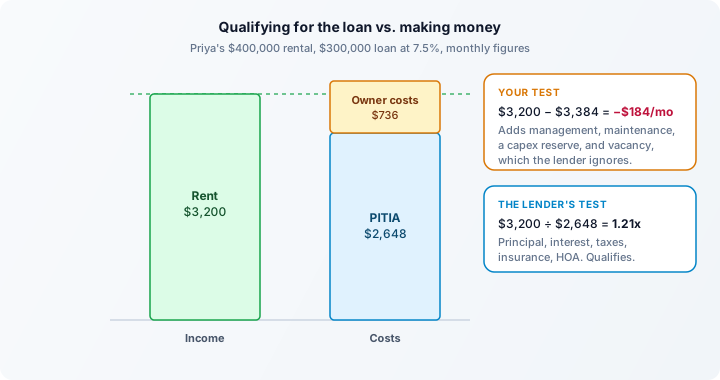
Priya's real monthly cash flow: $3,200 − $2,647.64 − $736 = −$183.64
The loan qualifies at 1.21x, and the property loses about $2,200 a year before taxes. It might still be a reasonable investment if she expects strong appreciation or rent growth, but she should go in knowing that, not discover it from her bank balance. Running only the lender's math is how investors end up feeding a property every month.
The DSCR loan calculator shows both numbers side by side: the lender's ratio and your cash flow after the expenses you enter.
Commercial DSCR: NOI ÷ debt service
If you've seen DSCR defined as net operating income ÷ annual debt service, you weren't wrong. That's the version commercial lenders and banks use for larger properties and business loans. It subtracts vacancy and operating expenses from the income first, and usually divides by principal and interest only.
For Priya's house:
- Residential DSCR loan: $3,200 rent ÷ $2,647.64 PITIA = 1.21x
- Commercial-style DSCR: $24,888 net operating income ÷ $25,171.72 annual principal and interest = 0.99x
The net operating income figure is the rent less 5% vacancy, taxes, insurance, management, and maintenance. Same property, same loan, two very different answers. Ask your lender which one they mean before you run the numbers.
Keeping the books after you close
A DSCR loan doesn't look at your books to approve you, but your books are how you find out whether the deal is working, and you'll need them anyway:
- Keep each property's money separate. If the loan is in an LLC, rent and expenses should run through the LLC's own bank account, not your personal one. Mixing them weakens the liability protection the LLC gives you.
- Split every mortgage payment. Interest is a deductible expense. Principal reduces the loan balance, and the escrow portion pays taxes and insurance. The rental property bookkeeping guide shows the journal entry.
- Compare actual results with what you projected. A monthly profit-and-loss report per property tells you whether vacancy and repairs are running above the numbers you used to justify the purchase.
- Have the paperwork ready for the next loan. When you refinance or buy again, lenders ask for leases, a rent roll, and sometimes a property-level operating statement.
In Sedna, each LLC gets its own set of books in one login (see multi-entity accounting), so you can run a profit-and-loss report for one property, or compare them side by side.
Key takeaway
A DSCR loan approves the property, not you: gross rent divided by the full monthly payment, including taxes, insurance, and HOA dues. Aim for 1.25x, and if you're short, interest-only or a longer term are the cheapest fixes. Then run the second test the lender skips. Subtract management, maintenance, reserves, and vacancy, and make sure the property still pays you.
Frequently asked questions
What is a DSCR loan? A DSCR (debt service coverage ratio) loan is an investment property mortgage that qualifies you on the property's rent instead of your personal income. The lender divides the monthly rent by the full monthly payment, including taxes, insurance, and HOA dues. If the ratio clears the lender's minimum, usually 1.00x to 1.25x, you qualify without tax returns, W-2s, or a debt-to-income calculation.
What DSCR do I need to qualify? Most lenders treat 1.25x and above as a strong file with their best rate and highest loan-to-value. Between 1.00x and 1.25x most standard programs still lend, often with a rate add-on. Some lenders offer low-DSCR programs down to about 0.75x at a higher rate, a lower loan-to-value, and larger reserves. Requirements vary by lender, so ask for their pricing grid.
Is DSCR calculated with NOI or gross rent? It depends on the loan. Residential DSCR loans on one-to-four-unit rentals divide gross rent by PITIA (principal, interest, taxes, insurance, and HOA dues), and ignore operating expenses like management and maintenance. Commercial and bank loans usually divide net operating income by annual principal and interest. The same property can show 1.21x one way and 0.99x the other, so confirm which definition your lender uses.
Can I get a DSCR loan in an LLC? Yes. Most DSCR lenders lend to LLCs, usually with a personal guarantee from the members. That's one reason investors who hold each property in its own LLC use them. Expect to provide the LLC's articles, operating agreement, and EIN letter.
How do I raise my DSCR if it comes in short? Lower the payment or raise the rent. An interest-only payment, a 40-year amortization, a larger down payment, a rate buydown, or cheaper insurance all shrink the payment. On the income side, a signed lease at or above market rent, or an appraiser's market rent that supports a higher figure, raises the numerator.
Does a 1.25x DSCR mean the property cash flows? No. The ratio only compares rent to the housing payment. You also pay property management, maintenance, a reserve for big repairs, any owner-paid utilities, and lose rent during vacancies. A property at 1.21x can lose money every month once those costs are counted, so run your own cash flow alongside the lender's ratio.
Related
- DSCR loan calculator: your ratio, the largest loan that clears 1.00x and 1.25x, and your real cash flow
- Cap rate vs. cash-on-cash return: the two numbers that tell you whether the deal is worth doing
- Rental property bookkeeping: recording rent, expenses, and mortgage payments once you own it
- Multi-entity accounting: one set of books per LLC, in one place
- LLC guide: how an LLC protects you, and what it takes to keep that protection
Disclaimer
This guide explains how DSCR loans are commonly underwritten. It is not lending, legal, tax, or financial advice. Ratio thresholds, loan-to-value limits, reserve requirements, and prepayment terms vary by lender and change with market conditions. The figures in the example are illustrative. Talk to a licensed loan officer about your situation before you commit to a property or a loan.
Try it in Sedna
See this in action in the app. Open in app