
Cap Rate vs. Cash-on-Cash Return, With Examples
How to calculate cap rate and cash-on-cash return on the same rental, when to use each, and why a 6.2% cap rate can still mean a negative return.
10 min readPublished · Updated
Cap rate is a rental's net operating income divided by its price, so it measures the property before any loan. Cash-on-cash return is the cash flow left after the mortgage divided by the cash you put in, so it measures your deal with your financing.
Listings and investor forums often quote the two as if they were interchangeable. They're not. They answer different questions, and on the same property one can look healthy while the other is negative.
This guide calculates both from one property, step by step, and shows when to use each, why they can point in opposite directions, and how to get the real numbers from your books once you own the property.
At a glance
- Cap rate = net operating income ÷ price. It measures the property, with no loan involved.
- Cash-on-cash = annual cash flow after the mortgage ÷ cash you put in. It measures your deal.
- Use cap rate to compare properties and test the price. Use cash-on-cash to decide if the deal is worth your cash.
- If the cap rate is below your loan's annual cost, borrowing lowers your return
- Neither one counts appreciation, loan paydown, or tax savings
The example property
Priya is looking at a single-family rental listed at $400,000. It rents for $3,200 a month, there's no HOA, and the tenant pays the utilities. Here's what it costs to run in a year:
- Property taxes: $4,800
- Insurance: $1,800
- Property management: 8% of rent, $3,072
- Maintenance and repairs: 5% of rent, $1,920
- Vacancy: about 5% of rent, $1,920 lost
- A reserve for big replacements (roof, HVAC, water heater): 5% of rent, $1,920
If she buys, she'll put 25% down, borrow $300,000 at 7.5% over 30 years (an example rate), and pay about $12,000 in closing costs.
How to calculate cap rate
Cap rate = net operating income (NOI) ÷ purchase price
Net operating income is what the property earns after running costs but before any mortgage payment. Build it from the top:
| Line | Annual |
|---|---|
| Gross rent ($3,200 × 12) | $38,400 |
| Less vacancy (5%) | −$1,920 |
| Effective gross income | $36,480 |
| Property taxes | −$4,800 |
| Insurance | −$1,800 |
| Property management | −$3,072 |
| Maintenance and repairs | −$1,920 |
| Net operating income | $24,888 |
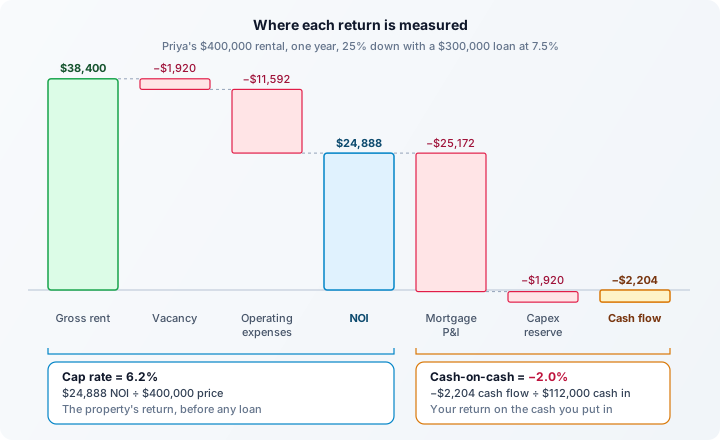
Cap rate = $24,888 ÷ $400,000 = 6.2%
What NOI leaves out, on purpose:
- Mortgage payments. Financing is about the buyer, not the building. Two buyers bidding on this house get the same NOI and the same cap rate, however they pay for it.
- Capital improvements and replacement reserves. A new roof is an asset you depreciate, not an operating cost. (Some analysts do include a reserve in NOI, so check when you compare someone else's numbers.)
- Depreciation and income taxes. Those depend on the owner's tax situation, not the property.
Using cap rate to value a property
Because cap rate doesn't depend on financing, you can compare it directly with recent sales of similar properties nearby. Turn the formula around and it values the property:
Value = NOI ÷ market cap rate
If similar rentals in the area sell at a 6.5% cap rate, Priya's house is worth about $24,888 ÷ 0.065 = $382,892 on its income, so the $400,000 asking price is a bit rich. If they sell at 5.5%, it's worth about $452,509, and the listing looks cheap.
The cap rate calculator builds the NOI for you, values it at a market cap rate, and compares several properties side by side.
How to calculate cash-on-cash return
Cash-on-cash return = annual pre-tax cash flow ÷ total cash invested
Cash flow is what's left of NOI after the mortgage and the reserve for big replacements. Cash invested is everything you put in at the start: down payment, closing costs, and any repairs before the first tenant.
For Priya with 25% down:
| Line | Annual |
|---|---|
| Net operating income | $24,888 |
| Mortgage principal and interest ($2,097.64 × 12) | −$25,172 |
| Reserve for big replacements | −$1,920 |
| Pre-tax cash flow | −$2,204 |
Cash invested = $100,000 down + $12,000 closing costs = $112,000
Cash-on-cash = −$2,204 ÷ $112,000 = −2.0%
The property earns a respectable 6.2% before financing, and Priya's cash earns −2.0% after it. She'd be adding about $184 a month to keep it running.
Cap rate vs. cash-on-cash, side by side
| Cap rate | Cash-on-cash return | |
|---|---|---|
| Formula | NOI ÷ price | Cash flow after the mortgage ÷ cash invested |
| Measures | The property | Your deal, with your financing |
| Includes the mortgage? | No | Yes |
| Same for every buyer? | Yes | No, it changes with down payment, rate, and term |
| Best for | Comparing properties, checking the price | Deciding if the deal is worth your cash |
| Leaves out | Financing, taxes, appreciation | Appreciation, loan paydown, tax benefits |
Why a 6.2% cap rate gave a negative return
Borrowing only helps if the money you borrow earns more than it costs. The cost of Priya's loan, as a yearly percentage, is its loan constant:
Loan constant = annual principal and interest ÷ loan amount = $25,172 ÷ $300,000 = 8.4%
Each borrowed dollar costs her 8.4 cents a year, but the property earns only about 6.2 cents on each dollar of value. Every dollar she borrows loses money, so the more she borrows, the worse her return gets. That's called negative leverage:
| How Priya pays | Cash invested | Annual cash flow | Cash-on-cash |
|---|---|---|---|
| All cash | $412,000 | $22,968 | 5.6% |
| 50% down ($200,000 loan) | $212,000 | $6,187 | 2.9% |
| 25% down ($300,000 loan) | $112,000 | −$2,204 | −2.0% |
(The all-cash return is below the 6.2% cap rate because the cash invested includes closing costs, and the replacement reserve comes out of cash flow.)
Now suppose the same house produced $40,000 of NOI, a 10% cap rate. That beats the 8.4% loan constant, so borrowing works in her favor:
| How Priya pays | Cash-on-cash |
|---|---|
| All cash | 9.2% |
| 25% down | 11.5% |
That's positive leverage, and it's the whole reason investors borrow. When cap rates sit below mortgage rates, as they often do in expensive markets, the math runs the other way.
Note
What's a good cap rate and cash-on-cash return?
Cap rate: there isn't a national standard. A low cap rate in a stable, high-demand area and a high cap rate in a weaker one can both be fairly priced, because cap rate is partly payment for risk. Compare against recent sales of similar properties in the same area. A cap rate far above the local norm usually means more risk or optimistic numbers, not a bargain.
Cash-on-cash: compare it with what the same cash could earn elsewhere at similar risk, and remember what it leaves out:
- Appreciation. A property that rises in value can be a good investment at a low cash-on-cash return.
- Loan paydown. Part of each mortgage payment builds your equity. Cash-on-cash counts it as a cost.
- Tax benefits. Depreciation can shelter much of the rental income from tax in the early years. Some of that tax comes back when you sell (depreciation recapture, taxed at up to 25%), but deferring it still has value.
For the full picture over the years you'll hold the property, investors use total return or internal rate of return (IRR). Cash-on-cash is the first-year, cash-only view.
Mistakes that inflate both numbers
- Trusting the seller's expenses. Listing sheets often leave out management, maintenance, or vacancy. Once every cost is counted, a typical rental's running costs are often 35–50% of the rent it collects. Priya's come to 37% including the replacement reserve, at the lean end because she pays no HOA dues or utilities.
- Using the seller's property tax bill. Many counties reassess at your purchase price, so your tax bill can be much higher than the seller's.
- Skipping management because you'll self-manage. Your time has a cost, and leaving it out makes the property look better than it would to the next buyer.
- Comparing cap rates across different markets. A 9% cap rate in one city isn't "better" than a 5% cap rate in another; it's priced for different risk.
- Quoting cash-on-cash without the financing. "12% cash-on-cash" means nothing without the down payment and rate behind it.
How to calculate NOI from your books
Projections are guesses. Once you own the property, your books tell you what it actually earned, and that's the number to compare with what you expected.
NOI from your profit-and-loss report:
NOI = net income + mortgage interest + depreciation + amortization
Mortgage interest, depreciation, and amortization all appear on a rental's profit-and-loss statement, but none of them are operating expenses, so add them back. Also take out anything one-time that isn't part of running the property, like a legal settlement or a gain on a sale. Capital improvements aren't on the profit-and-loss statement at all (they're recorded as assets), so there's nothing to remove for them.
Cash flow for cash-on-cash: take that NOI, subtract the full mortgage payments (principal and interest), and subtract what you spent on capital improvements during the year.
This only works if each property's money is kept separate, so the report shows one property and not a mix. In Sedna, each LLC gets its own books (see multi-entity accounting), and the rental property bookkeeping guide shows how to record rent, repairs, and mortgage payments so these reports come out right.
Run the numbers
- Cap rate calculator: NOI, cap rate, gross rent multiplier, value at a market cap rate, and a side-by-side comparison of several properties
- DSCR loan calculator: whether the rent covers the loan, and your monthly cash flow after expenses
- Real estate deal analyzer: financing, holding costs, and refinance math for one deal in detail
- Cash-on-cash calculator: ranks flips and other short projects by the return on your cash, scaled to a year
Key takeaway
Cap rate prices the property and ignores how you pay for it. Cash-on-cash return measures what your cash earns with your actual loan. Use cap rate to compare properties and test the price, and cash-on-cash to decide whether the deal is worth doing. Before you borrow, compare the cap rate with your loan constant: when the cap rate is lower, more debt makes your return worse, not better.
Frequently asked questions
What is the difference between cap rate and cash-on-cash return? Cap rate measures the property: net operating income divided by the price, with no loan involved, so every buyer gets the same number. Cash-on-cash return measures your deal: the cash flow left after the mortgage, divided by the cash you actually put in. Cap rate tells you whether the price is fair. Cash-on-cash tells you what your money earns with your financing.
Which is better, cap rate or cash-on-cash return? Neither. They answer different questions, so use both. Use cap rate to compare properties and check the price against similar sales. Use cash-on-cash return to decide whether the deal, financed the way you plan to finance it, earns enough on your cash to be worth doing.
Can cash-on-cash return be higher than the cap rate? Yes, when borrowing helps. If the property's cap rate is higher than the loan constant (annual mortgage payments divided by the loan amount), each borrowed dollar earns more than it costs, and cash-on-cash rises above the cap rate. If the cap rate is lower than the loan constant, borrowing drags cash-on-cash below the cap rate, and can make it negative.
Does cap rate include the mortgage payment? No. Net operating income is calculated before any mortgage payment, so cap rate is the same no matter how the property is financed. Cash-on-cash return is the measure that includes the mortgage.
What is a good cash-on-cash return for a rental property? There's no universal number. Compare it with what your cash could earn elsewhere at similar risk, and remember what it leaves out: appreciation, loan paydown, and tax benefits like depreciation. A low cash-on-cash return can be acceptable on a property you expect to appreciate, and a high one can hide an optimistic expense estimate.
How do I calculate NOI from my profit and loss statement? Start with net income for the property, then add back mortgage interest, depreciation, and amortization, since none of them are operating expenses. Also remove one-time items that aren't part of running the property, like a lawsuit settlement or a gain on a sale. What's left is net operating income.
Related
- DSCR loans explained: how lenders decide whether the rent covers the loan
- Rental property bookkeeping: recording rent, expenses, and mortgage payments
- Reading financial statements: how to read the profit-and-loss statement and balance sheet
- Multi-entity accounting: separate books for each property or LLC
Disclaimer
This guide explains how cap rate and cash-on-cash return are commonly calculated. It is not investment, tax, or financial advice. The figures in the example are illustrative, and real properties, markets, and loans vary. Talk to a qualified advisor before you buy a property.
Try it in Sedna
See this in action in the app. Open in app